Friday, 21 January 2011

Production company logo

We decided on 'STARGAZE PRODUCTIONS' as our production company name and Calum made a logo for use at the beginning of the trailer:

Wednesday, 19 January 2011

Music options/choices for trailer

Music in the genre of gangster is very important: a slower acoustic Italian-style is iconic of films like The Godfather.

(LINK/EMBED GODFATHER OPENING MUSIC)
The music playing during the first part of our trailer (the slower paced half), is Nancy Sinatra's 'Bang Bang'. We thought this was appropriate given the omnipresence of guns in gangster films, and the recurring theme in our film. The words 'bang, bang' in conjunction with the calm tone of the music also provides a disturbing juxtaposition for the viewer.

Nancy Sinatra


During the second segment of our trailer, we are using The Prodigy's 'Breathe'.
A shot from the 'Breathe' music video.

This is because this half of the trailer is much faster paced visually and in terms of content, as is the convention for action film trailers: the beginning will introduce the characters and signal that the film too will start less aggressively.

The trailer reaches a climax and the action begins. 'Breathe' is an aggressive, arousing piece of music and will excite the viewer to potentially go and see it.


[EMBED 'BREATHE']

Thursday, 13 January 2011

Basic plot


  • Two lovers, children of rival gang leaders, have a relationship in secret.
    Despite their efforts, their fathers (or one of them) discovers this and orders the assassination of them both.

  • The couple are interrupted while together by a ‘hitman’ and are seemingly both killed. Their bodies are thrown into a harbour.

  • The girl survives, though injured. Her lover is dead. She is bent on revenge against her father.

  • She kills her assassin. She also kills many more people on her journey to her father. She does this seemingly without hesitation.

  • Her father discovers that it is his daughter killing his men. Rather than feeling remorse or paternal compassion he steps up his game and orders her immediate death.

  • She eventually finds him but leaves him to live, though a broken and helpless man.

    The following diagram shows the flow of events as seen in both the feature film and the trailer.


You can see that while most of the pre-climactic events are condensed in the trailer, the 'action' is excluded and so the audience will not feel like anything significant has been given away, since thrillers like this are seen for the characters and action as well as just the storyline.

The final point is not touched on at all in the trailer, obviously, as this would reveal the ending.

Final typeface for title and taglines

To create our movies title ‘logo’, we decided on the free-for-use typeface ‘Ghetto Marquee’ by Kirk Shelton, found on Dafont.com:


We liked it because it has the effect of ‘tablets’ built in, which I think are reminiscent of the classic movie advertisements you might have seen many years ago at a movie theatre. The worn and dirtied effect gives the viewer the image of disuse. It suits the film because it is sympathetic with how battered the main character is. The splattering is reminiscent of the bloodshed in the gangster underworld and the crookedness signifies the disorder and unpredictability in the film.

This is what our film title looks like in the font:


In our trailer, we are using strong phrases that relate to the story to give the audience a little more information. One of these is 'FORBIDDEN LOVE'. We decided to use the same typeface as the title, but to make them look more 'beaten up', I used Adobe Photoshop to make some of the tablets crooked, and also adjusted the second 'E' so it looked different from the first. We also gave it a red hue to distinguish them from the title:

Friday, 10 December 2010

Practicality: Pro's and Con's of 'Gangster'

Pros


  • Costumes are relatively simple and recognisable: suits, jackets, etc. Easy to obtain.

  • Locations are very easy as well -- offices, streets, alleys, etc. All relatively accessible, and London, an ideal location, is well within practical travelling distance.

  • Few props are needed other than guns as the storyline would be, for the most part, based on a naturalistic urban environment.

  • Characters are either young adult or middle ages, so it is not difficult to find a cast. We will likely be using friends and parents.

Cons


  • Weapons are an essential component in the gangster genre. Replicas might not be so difficult to obtain, but possessing them in a public place, or at least having them in plain sight, is against the law and potentially dangerous for the carrier.

  • Sports cars and boats, which are potentially useful symbols of power in the genre are difficult to obtain, but luckily we potentially have access to these at our disposal if we were to choose to use them.

The genre of 'Gangster' and themes

We are working in the film genre of gangster. Though this provides a large number of themes, conventions, and toolkits for devising creatively, we wanted to make sure this didn't limit us.


Films of this genre typically involve a man fighting for or against an organisation. An example of this is the film-noir classic 'The Big Heat' (1953) by Fritz Lang, where an ex detective bent on revenge goes out to destroy a large-scale crime operation.


Crucially, we are using a female protaganist and we feel that this allows us to discuss the ideas of female strength, father-daughter relationships, and play with vulnerability and naivité using the stereotype of a young girl as a catalyst. A convention often featured in films of this type is the ambiguity of this good-bad definition -- a bad character might seeming uncharacteristic tendencies of compassion or a good character lapses into a senseless and dark pursuit of revenge. The theme of revenge is a very effective way of portraying this ambiguity, where a character 'sees red' and is dangerously obsessive. This links back into the vulnerability as a character might have a point of self-realisation.

Thursday, 18 November 2010

Kill Bill Poster Analysis

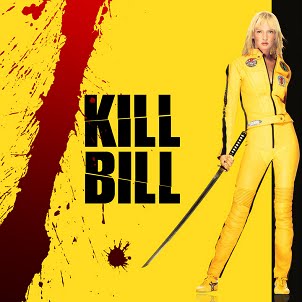
  • This is a theatrical poster for the first volume of the duology. Instantly, the first noticeable characteristic is the colour scheme. Red, yellow, and black, are nature’s “warning colours”. We see them on insects, animals, plants, and fire; all these things might pose a threat. A person’s eye is therefore drawn to the poster with intrigue and wariness.
  • The characters direct mode of address is also intimidating, and her solitude suggests she is central to the plot. These are used to attract and excite a potential audience who might enjoy the thrill of dangerous exploit. In addition, the juxtaposition of the yellow and black is striking and bold. The yellow might also be a reference to the post-femininity of the film, and the ‘blonde’ stereotype broken by the lead actress. It could too arguably be an ironic twist on the happiness and cheeriness culturally implied by the vivid yellow. The style later becomes absolutely iconic to the series.
  • The blood on the poster is an unmistakable code: this film will be bloody. True to this conjecture, the films have been described as “the most violent ever made”. An audience with specific interest in gory or high-octane films will now already be interested. This would typically be a more masculine interest, and this masculine appeal is further affirmed by the ‘sexy’ depiction of Uma Thurman, the lead actress in the films.
  • Continuing with the black and yellow theme, the tight-fitting and part-unzipped racing suit is both a symbol of her female carnality and her solidarity. The badges give her an almost petrol-head image which is yet another appealing factor for a potential male audience.
  • The typography of the title is heavy-duty and outstanding. Again, it is black and in contrast to the prevailing yellow all around it. The title itself is actually perceptibly strong. They are two similar, and rhyming, words that resound in the viewer’s head. Perhaps this is because of the sinister nature of the word ‘KILL’ and the seeming impotence and normality of the name ‘BILL’.
  • Another recurring theme in the poster is the cutting or slashing. The samurai sword in the character’s hand is another enigma code. The audience is instantly wondering what she is going to do with the sword and crucially, who she is going to do it to. The audience’s suspicions are confirmed in the title, which implies, of course, that her target is ‘Bill’. However, the audience is then left wondering who Bill is, and why she is intent on causing him harm.
    There are slashes through the title itself, and a similarly shaped blood spatter, indicating that swords and their use as an offensive weapon will be central to the story line. It is arguable, too, that the sword is also symbolic in other ways. From a Freudian perspective, a sword is a phallic, sexual symbol and a figure of masculinity. Also, in Chinese symbolism, a woman drawing a sword is suggestive of childbirth. Tarantino is well-known to have a special interest in Asian culture and arts, and a crucial trigger to the plotline is the retrieval of the central character’s new-born child.